Human Factors: Beyond Human Engineering
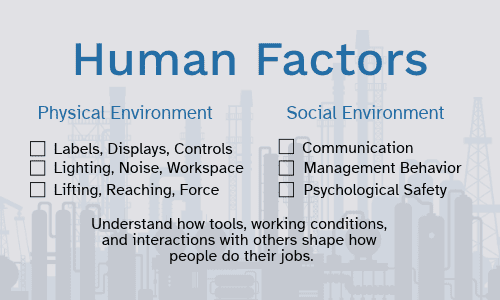
When people hear “human factors,” they often picture displays, controls, and workspace layout. Those are part of the physical environment. But there’s also a social environment. The social environment is shaped by how people communicate, how supervisors respond to concerns, and how safe workers feel speaking up when something seems wrong.
Human factors draws on engineering, psychology, and other disciplines to understand how people interact with the systems they work in. The goal is to design work around human capabilities and limitations.
Think about an operator who notices an unusual reading. The display design can affect how easy it is to spot the change. How the supervisor has responded to concerns in the past can affect how quickly the operator raises it. That’s how the physical and social environments can shape what happens in the same moment.
Every Workplace Has a Social Environment
Imagine an employee operating a machine. The instructions are posted behind the workstation, so the employee has to turn around each time they need to check a step. One step is unclear, but the employee hesitates to ask for clarification. Their supervisor has said that experienced workers should already know how to do the job.
A walkthrough can show you where the instructions are posted. To understand why the employee hesitated, you’d want to ask what usually happens when someone has a question, asks for help, or reports a problem. You’d also want to know how quickly people are expected to work and what happens when someone makes a mistake. Those everyday expectations shape the social environment.
The physical environment in this example makes the instructions harder to use. The social environment makes it harder to ask for help when the instructions are unclear.
The Social Environment Influences Human Behavior
A company’s written policy encourages employees to report hazards. But on the production floor, supervisors praise workers for meeting targets and criticize them when they stop work to address a problem. After seeing a coworker get criticized for stopping the line, an employee who spots a hazard on the next shift may decide to wait until break to mention it. That’s how people learn what’s expected of them in practice.
This is where psychological safety comes in. Psychological safety and human factors are deeply and directly related. It’s the shared belief that people can ask questions, admit mistakes, raise concerns, or challenge an idea without fear of humiliation or punishment. When speaking up feels risky, information that could help prevent an incident may reach the people who can act on it too late.
In an investigation, ask about what people noticed, what they shared, and what shaped the timing. What happened the last time someone reported a similar problem? How did the supervisor respond? What did others on the shift take away from that response?
Where Social Environment Shows Up on the TapRooT® Root Cause Tree®
When an incident occurs, it’s easy to focus on the person closest to the event.
- Why didn’t the employee follow the instructions?
- Why didn’t they recognize the hazard?
- Why didn’t they speak up?
Before answering those questions, establish what happened. What instructions were available? What could the employee see from where they stood? What concerns had they already shared, and how did others respond?
Several Basic Cause Categories can help you explore how both the physical and social environments shaped what happened.
- Management System. What did management reinforce through its decisions and oversight? For example, how did supervisors respond when employees stopped work to address a hazard?
- Communications. What information did people share, and what did others understand? If a concern came up near the end of a shift, find out what was passed along at turnover and what influenced that exchange.
- Training. What had employees been taught and given a chance to practice? If people hesitated to ask for help, find out how they were expected to handle a task they were unsure about.
- Procedures. Were the instructions clear and practical under the conditions people actually worked in? If employees routinely worked around a step, find out what made the step hard to follow and what happened when someone raised the issue.
- Human Engineering. How did the equipment, controls, displays, or workspace affect the task? At the machine in the earlier example, I’d check where the instructions were posted and how easily an employee could refer to them while working. When instructions are hard to use, workers may need to ask for help more often. That makes the supervisor’s response to questions part of understanding how the task actually gets done.
An employee’s reluctance to ask for help is a condition of the social environment. Find out what may be contributing to it.

The Employee Who Didn’t Speak Up
An employee hears an unusual noise coming from a machine and continues working. Several hours later, the machine fails. During the investigation, the employee says they held off reporting the noise because they didn’t want to interrupt production.
Ask questions about what the employee understood about the noise at the time. Had they heard it before? What did they think it meant? Also, ask them to walk you through what usually happened when someone reported an equipment problem. Could the employee tell a supervisor about the noise without stopping the machine? Who decided when to stop production? What happened the last time someone raised a similar concern?
I’d compare that account with what coworkers and supervisors recall and with any available maintenance records. That evidence would help me determine if the missed report was a potential Causal Factor and examine the conditions around it. For example, if workers had raised similar concerns before and never heard what happened next, I’d look at how those reports were handled and how decisions were communicated back to the shift.
Look Beyond the Physical Environment
The next time you walk through your workplace, pick one task and ask someone to show you how they do it. Look at the physical environment: equipment, lighting, noise, and layout. Then ask what happens when something interrupts the task or seems wrong. If a machine starts making an unusual noise, who do they tell? Who decides if the machine keeps running? What kind of feedback is the worker receiving when they report things like this?
When we design work, we shape the physical conditions/environment people work in and the social conditions/environment they work under. The placement of a display can affect how quickly someone notices a problem. The response they got the last time they raised a concern can affect how quickly they report it. Looking at those conditions together can help us see where the work system needs to change.

Human Performance is Influenced by the Social and Physical Environment
The TapRooT® Root Cause Analysis System is built on human factors principles. It recognizes that human performance is influenced by the systems and environments people work in, including physical conditions, management decisions, communication, training, and workplace expectations.
Our 2-Day TapRooT® Root Cause Analysis Training teaches you how to apply these principles during incident investigations. Using a systematic, evidence-based approach, you’ll learn to identify the underlying system weaknesses that contribute to incidents and develop effective corrective actions to prevent recurrence.
Go beyond human error. Learn to identify and address the conditions that influence human performance.