Friday Jokes

Friday Jokes are memes, videos, and anything funny! Tune in every week for another joke that may (or may not) relate to root cause analysis.
Eyes on you
10/09/2026
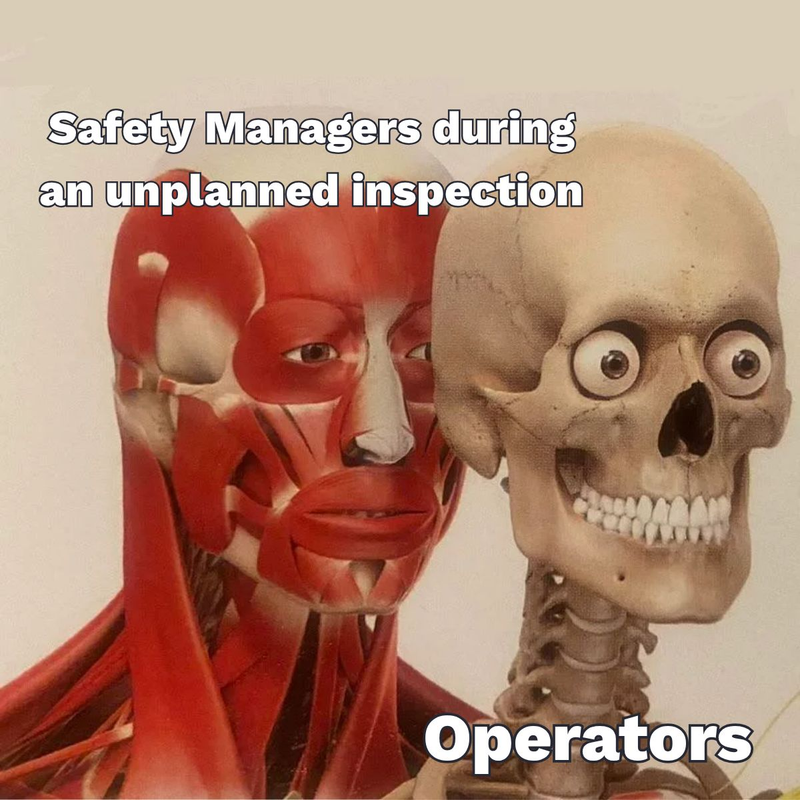
Unplanned inspections: is it possible to take safety too far?
Safety audits are obviously critical, but how they’re conducted can spark some debate.
In most industries, inspections are usually planned and announced well in advance.
This approach is communicative and transparent. It can also prompt operators to shape up on a recurring basis.
However, planned audits may inadvertently encourage teams to put on a dog and pony show. If everyone knows exactly when and where the inspector will be, why should they bother keeping tidy outside of their watch?
Inversely, unplanned inspections can certainly keep operators on their toes — sometimes, to a fault.
Knowing that an audit can happen at any time is a strong motivator, but it’s not necessarily a healthy one. If inspections are used as a threat to get workers in trouble, management is establishing a culture of fear and distrust.
Whether planned or not, audits will not magically improve behavior. They’re a means to measure and understand human performance.
An ideal inspections doesn’t catch workers who make mistakes. It finds system faults that facilitate those mistakes.
Baring teeth
10/02/2026
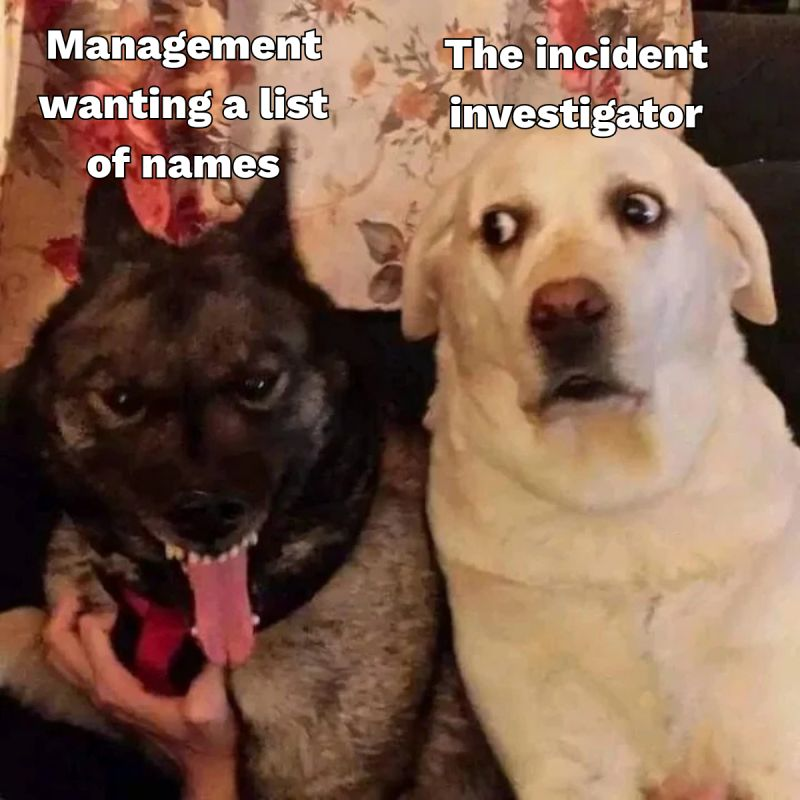
Managers may want to know who was involved in a minor incident. This might seem like a simple ask, but it can actually take an investigation off the rails for a number of reasons:
🔧 Fix systems, not people.
A list of names will not help you achieve effective corrective actions. If someone made a mistake, look at improving which systems facilitated the error.
Disciplining everyone involved will only teach workers to cover up the mistake the next time it happens.
🧠 Everyone has preconceptions.
In TapRooT® Training, we tell investigators to exclude names on the event timeline. This is because we all have our biases, and even seeing a name can skew our decision-making.
Having more authority doesn’t make our preconceptions more accurate. Be objective and charitable in your analysis.
✅ Anonymity can provide better evidence.
Even if our ultimate goal is a blame-free investigation, the mere perception of distrust can shatter that.
Workers far less likely to provide accurate information if they think it can be used against them.
AAAAAAAHH!!
09/25/2026
Ever feel like workers are insistent to endanger themselves? Let’s take a step back and consider some deeply rooted issues that can encourage this attitude:
• The PPE could be cumbersome.
If workers don’t want to wear the PPE, it might not be comfortable for the job. Attire that limits mobility will be viewed as an obstacle.
Furthermore, PPE should always be accessible. Provide extras in case workers forget to bring or accidentally damage their own.
• When production comes first, safety becomes secondary.
If workers face strict deadlines or quotas, anything that slows them down, no matter how critical, will lose priority.
Actions speak louder than words. Management should not only communicate the importance of safety, but also incentivize safe operations.
• Ask for yourself.
We could rattle off potential reasons for avoiding PPE until the end time. If you’re facing compliance issues, the real answers will come from your workforce.
2-way communication is key to understanding human performance problems. Otherwise, our corrective actions are only leaps of faith.
True, but unhelpful
09/18/2026
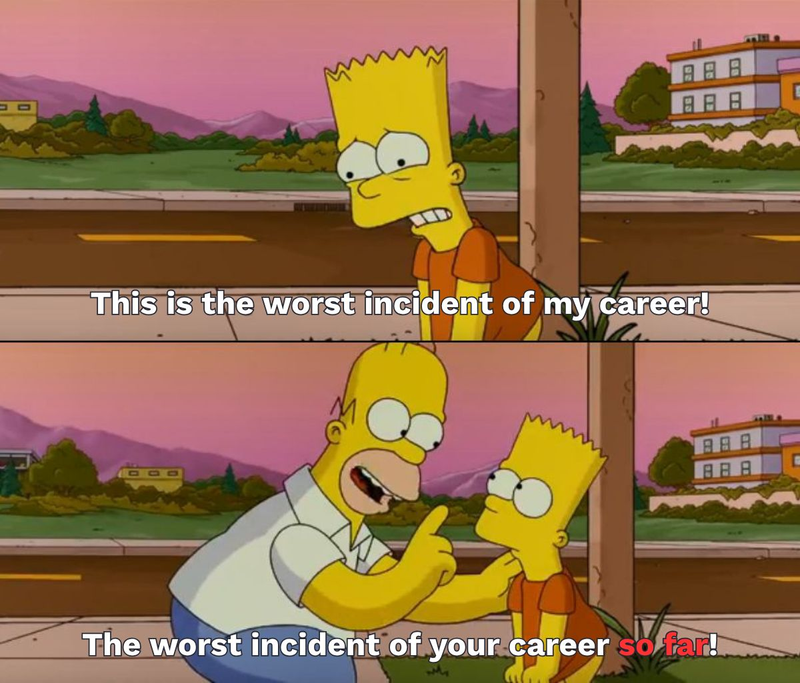
It only gets worse from here. 🙂
That is, unless, you do something about it.
In the TapRooT® Process, we call near misses Precursor Incidents. That’s because these moments reveal problems that will result in a major accident later down the line if they remained unaddressed.
Moreover, serious injuries and fatalities (SIFs) show more pressing faults in your safety systems.
While it’s perfectly normal to feel distressed in these situations, remember that you have the power to fix these problems once and for all.
RIP ✌️😂

Rest in peace, burdensome paperwork. You won’t be missed!
We’ve all felt the dread of filling out redundant, unnecessary documentation. How can we manage this problem in the workplace?
Safety clutter is never malicious; every form was made with good intentions. An overbearing amount indicates there’s no system to optimize the current load.
With that being said, someone needs to investigate what can be cut or mitigated. That might seem obvious, but, clearly, no one has tried yet.
Sure, evaluating all your documents might be a big project. Doing so, however, can save your entire team lots of time and effort in the long run.
Consider the following optimizations:
• Are there overlapping fields to fill out?
• Are any fields not relevant to the document?
• Can similar forms be merged into one?
• Does the document need to exist at all?
You’ll likely need managerial involvement to implement these changes, so it’s important to collect and present evidence on how the paperwork has become overbearing.
Furthermore, it could be worthwhile to perform these evaluations proactively, rather than waiting until the clutter has become so burdensome that the team has resorted to pencil-whipping.
WHAM!
09/04/2026

Right when you’re back on track… WHAM! Another major incident!
Incidents investigations are often thrown onto the laps of teams with already limited resources. Here are a few tips to make them less painful.
📋 Develop a plan beforehand.
If you can’t realistically perform your normal tasks while conducting an investigation, consider which tasks can be reallocated prior to an incident.
This might require management involvement, so the sooner you develop a game-plan, the better understanding everyone has of the process.
🏃 Dedicate time to investigate proactively.
If there’s already time on your calendar to perform root cause analysis, a major incident will be less intrusive to your time.
Furthermore, major incidents are far less likely to occur if you take care of minor ones effectively.
🏋 Train, train, train!
It doesn’t matter how frequent your investigations are if you’re not looking outside your own scope of knowledge. No one should have to perform an incident investigation without proper training.
Um… 👀
08/28/2026

Well, uh… this is awkward. Who wants to tell management about the management root causes?
It’s not easy to dive into this topic, especially after a major incident, but it’s necessary if we want meaningful improvements.
For starters, lead by a blame-free example. Just as we expect our supervisors not to blame individual workers, we can’t point fingers at executive team members. Clearly establish that we need to fix management SYSTEM root causes, not specific managers.
Even still, the executive team might not like to hear that their baby is ugly. That’s why it’s important to always show your work. Cite your sources and present a clear outline of your investigation process. More evidence means a more convincing corrective action.
This is where I come to cry 🙂
08/21/2026

New hire training… How can we set strong expectations from Day 1?
First impressions matter. In fact, in psychology, we call this the Primacy Effect. It’s a cognitive shortcut where our brains disproportionately remember and weigh information we receive first over intel presented later.
If a new hire immediately sees colleagues taking shortcuts, for instance, that will have a lasting impact on what they perceive as acceptable. Inversely, if management is present for the hiring process, even for a simple handshake, they demonstrate care in that day-to-day operations.
That being said, it’s important to understand that you can’t hire and fire our way into a healthy work environment.
New employees become a part of the company culture whether you’re happy of its current state or not.
Even if the entire staff was somehow replaced, the newbies will eventually fall victim to the same system faults that facilitated the adverse behaviors in the first place: poor communication, lackluster enforcement, bad human engineering, et cetera.
So, if you have high expectations for your new hires, make sure your systems provide the tools to help everyone reach their goals.
I know what we have to do…
08/14/2026

Improvement can feel daunting, even impossible, in a stagnant work environment.
Incident investigators may feel discouraged when leadership is adverse to change, but there are important reasons to keep putting your best foot forward:
• Giving up doesn’t fix anything.
You know the umpteenth retraining session won’t fix the constant incidents.
Having your suggestions fall through is frustrating, but the problems at your workplace will get worse before they get better if they continue to be unaddressed.
• Safety is more than a checklist.
Remember what’s the stake: the safety and well-being of your team. Going the extra mile to improve your safety systems can save lives.
• There are tools at your disposal.
We’re here to help. TapRooT® RCA is designed to find and fix the generic problems roadblocking your company.
Improvement is never impossible. There are always solutions; it’s a matter of finding them.
Lacking substance
08/07/2026

CAPA: It’s great in theory, but it really lacks substance.
CAPA (Corrective Action, Preventative Action) is the concept of handling incidents both reactively and proactively. Action should be taken to handle the situation immediately, but safeguards also need to be added to prevent its reoccurrence.
That’s great, but CAPA provides little guidance on what effective corrective or preventative actions are.
Let’s say a worker violates a procedure, leading to a minor incident.
Discipline is a common corrective action when it comes to human error. Further investigation would reveal the procedures are confusing, the worker felt time-pressured, and there’s an unhealthy company culture.
In this case, discipline would result in frustration, not improvement.
To make matters worse, the preventative action is likely to fail, too, without any direction in human performance.
Often times, teams fall back to initiating retraining or expanding the procedures. Most investigators don’t have the experience to pinpoint or fix the underlying causes.
CAPA is a wonderful concept, but that’s all it is: a concept. It needs to be used alongside a robust investigation model to be used meaningfully.