Lessons Learned: Water Injector Well Pressure Tests Fail
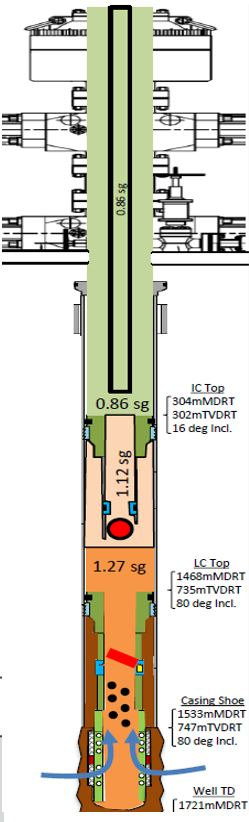
A water injector well’s positive and negative pressure tests both fail, resulting in an influx with little time to respond.
Water injector well with completion operations ongoing with overbalanced brine; a Lower Completion (LC) was installed at top of reservoir with a breakable Fluid Loss Flapper – preventing brine losses, closing on flow from Top to Bottom.
Just above, there is an Intermediate Completion (IC) equipped with an Injection Valve – for future water injection – closing on flow Bottom to Top. The operation was to test well barriers before removing BOP. Both tests failed, and an influx was taken during the inflow (negative) test. Well shut in on BOP and killed.
What happened?
On a water injector well – completion operations with overbalanced brine, a Lower Completion (LC) was installed at top of reservoir with a breakable Fluid Loss Flapper – preventing brine losses, closing on flow from Top to Bottom.
Just above, there is an Intermediate Completion (IC) equipped with an Injection Valve – for future water injection – closing on flow Bottom to Top.
The operation was to test well barriers before N/down BOP. Pressurized well to 500 psi against LC Fluid Loss Flapper then bled off above IC Injection Valve in order to inflow test same. Pressure was not holding, suspected deep-set Fluid Loss Flapper not sealing properly.
Decision was taken to run DP down to intermediate completion at +/- 300m and displace base oil to inflow test the injection valve – displacement was performed BOP open. During the extended inflow test made on on trip tank, observed slight flow on a decreasing trend then changed to a sudden increase.
Well was shut in and pressures monitored (total 5m³ gain – SIDPP 300 psi / SICP 350 psi).
Displaced well back to brine from 300m – evacuated gas migrating – +/- 200 psi remaining.
Made several attempts to seal/test the Injection Valve without success. Tried to lubricate and bleed overbalanced brine, challenging operation due to well profile and completion design – could not reach well stability.
Decision made to break LC Fluid Loss Flapper and bullhead several volumes to recover well stability.
What went wrong?
- Loss of primary fluid barrier by performing an inflow test displacing an underbalance fluid.
- Failure of injection valve – low delta P preventing a good sealing and on injection valve.
- Detection failure allowing significant gain entering the well – bad diagnosis of the flow check behavior, not believing in an influx – suspecting U-tube from base oil displacement.
- Rig equipped with 2 trip tanks, transfer performed from one to the other during the flowcheck, adding to the diagnosis confusion.
- Displacement to base oil performed BOP open, loose accuracy in volumes and control of bottom hole pressure.
Corrective actions and recommendations
- The contingency plan (inflow test pumping base oil) not suitable in that scenario. Operation was not risk evaluated – case of the barriers failure during the test not considered.
- Strong human aspect, crew used to work in an “overbalanced” environment, not considering the risk of kick on the operation anomaly analysis.
- If low density fluid displacement, to be done, BOP should be closed controlling pressure at the choke, and bottom hole pressure constant.
- An inflow test at shallow depth (300m) is critical to react quickly when a kick occurs.
- Very low delta P (+/- 1.5 bar), not enough to seal tight the injection valve when doing an inflow test.
- Late detection of influx aggravated by transfer between trip tanks during extended flow check.
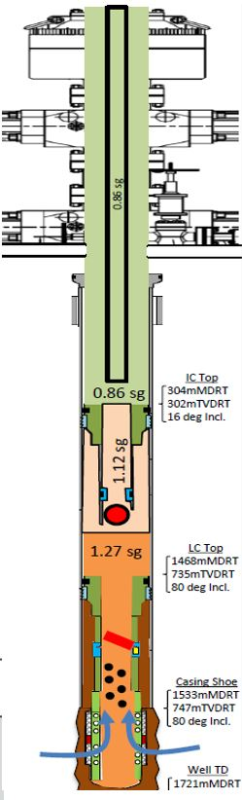
Content/image source/credit: IOGP (International Organization of Oil & Gas Producers), Well Control Lesson Sharing 26-15, “Positive and Negative pressure tests both fail, resulting in an influx with little time to respond.”