Fixing the Problems with 5-Whys

What Are the Problems with 5-Whys?
We’ve written about the problems with 5-Whys before. A few of the articles include:
- Under Scrutiny (Problems Using 5-Whys from Quality Progress)
- Teruyuki Minoura (Toyota Exec) Talks About Problems with 5-Whys
- What’s Wrong with 5-Whys
- Are You Dissatisfied with 5-Whys Root Cause Analysis?
- What’s Fundamentally Wrong with 5-Whys?
- 5-Whys Example – Is this Root Cause Analysis? (Updated)
If all those articles seem like too much reading, let me summarize those articles with these bullets of the problems with 5-Whys:
- Only Tool Misconception
- Confirmation Bias
- Single Cause Misconception
- Can’t Go Beyond Current Knowledge
- The Human Factor
- Lack of Practical Training
Or, here is a 15-minute video that simplifies the problems with 5-Whys…
But how do you fix the problems with this popular root cause analysis tool when it has so many things wrong with it? Believe it or not, we have answers. Read on to find out how to fix the problems with 5-Whys.
Fixing the Problems with 5-Whys

With so many problems, how can you fix 5-Whys? Read on because it is easy.
Only Tool Misconception
That’s an EASY problem to fix! Adopt a system with multiple tools. Read on for examples of the tools you will need.
Confirmation Bias
To avoid confirmation bias, apply the SnapCharT® Diagram technique. A SnapCharT® Diagram (example shown below) helps you focus on what happened BEFORE you jump to conclusions.
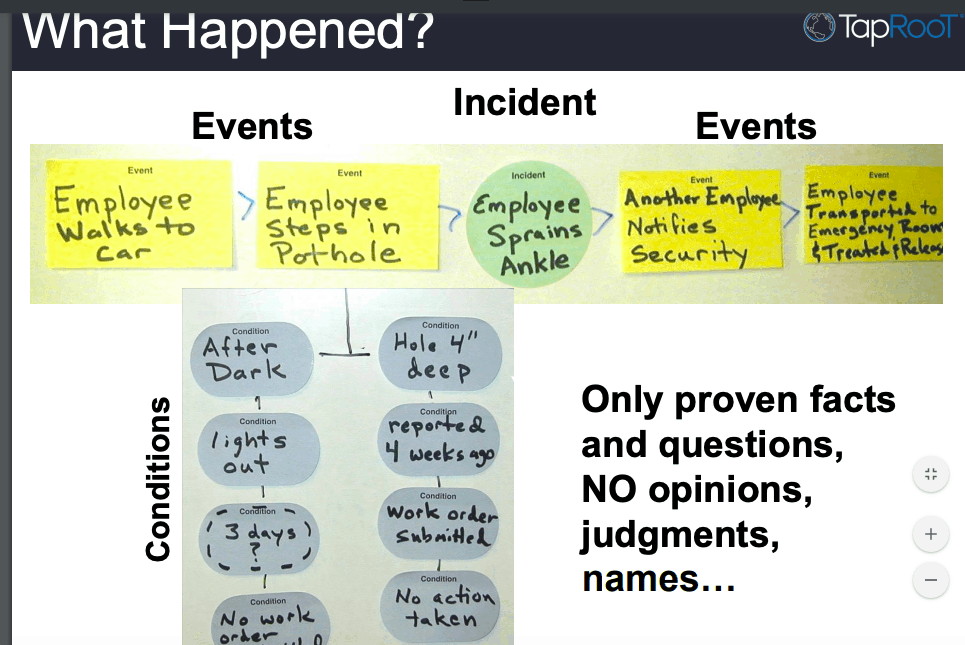
As you collect more information, you can add it to and organize it on a SnapCharT® Diagram.

Thus, a SnapCharT® Diagram helps you collect and organize the data that helps you understand the incident. You aren’t making assumpltions and if you have unproven facts or unanswered questions, you can highlight them by using dashed boxes or dashed ovals.
To learn more about drawing a SnapCharT® Diagram, CLICK HERE.
Single Cause Misconception
You might have noticed the four boxes in the SnapCharT® above that have triangles beside them. These are Causal Factors. Thus, when you draw a SnapCharT® Diagram, you can use the information to identify Causal Factors that led to the Incident (action in the circle). Almost always, there are multiple Causal Factors identified on a SnapCharT® Diagram and, thus, multiple root causes (one or more for each Causal Factor).

Looking for multiple Causal Factors with one or more root causes for each Causal Factor stops the single cause misconception.
To learn more about identifying Causal Factors using Safeguard Analysis, CLICK HERE.
Can’t Go Beyond Current Knowledge / The Human Factor
One of the most restrictive parts of 5-Whys is that the investigator or team can only look for reasons that they know. Thus, they can’t find causes that they don’t know about. This is especially troublesome when investigating human error because most investigators have never completed extensive human factors training. This leads to “human error” as being the “cause” of many human mistakes. The investigators don’t know the reasons for human errors.
However, with the proper guidance, investigators can be taught to look for human performance causes by using a guided system.
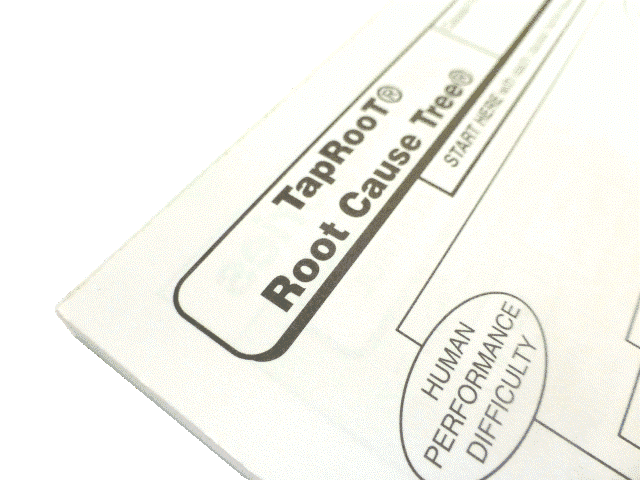
The TapRooT® Root Cause Tree® Diagram has several forms of guidance.
Here is the guidance given by the Root Cause Tree® Diagram’s Human Performance Troubleshooting Guide (15 Questions). The first question is “Was a person excessively fatigued, impaired, upset, bored, distracted, or overwhelmed?”

In the video below, Mark Paradies talks about investigators frequently overlooking fatigue when performing investigations.
If an investigator never asks about fatigue, they can’t find it as a root cause.
The Root Cause Tree® Diagram also has guidance once the investigator identifies one or more of the seven Basic Cause Categories for root causes. The Procedures root cause category is shown below.

The Human Performance Troubleshooting Guide has questions that will lead investigators to this category if there are potential procedure-related issues.
For each item in the Procedure Basic Cause Category above, there is a definition in the form of questions to answer in the Root Cause Tree® Dictionary.

Here are some of the reasons for procedures not being used or not being followed (the first column in the Procedures Basic Cause Category above), as suggested by the Root Cause Tree® Dictionary:
- There was no procedure.
- The procedure wasn’t available or wasn’t easily available for the user.
- The procedure was considered too difficult to use by the operator or mechanic.
- The procedure was written in a different language from the native tongue of the user.
- There is no requirement to use the procedure.
In the dictionary, each of these potential root causes has a series of questions that the investigator needs to find when identifying a root cause. And all of these questions are based on human factors research (an example of the research basis is shown in the procedures part of the tree shown above).
Thus, the investigator uses the Root Cause Tree® Diagram and Dictionary to guide them to human performance-related root causes based on human factors research. And all of this guidance has been extensively tested, proven, and continuously improved by real use in the field since it was first developed back in 1988.
How does this relate to asking why five times? If you look at the questions built into the guidance on the Root Cause Tree®, there are five levels of “Why” built into the tree’s guidance. Thus, the tree guides investigators to ask the right questions to find root causes (a guided 5-Whys).
Lack of Practical Training
You won’t find a practical “5-Why” course that includes the items above to fix the problems with 5-Whys. But you will find training in all the topics above in the:
- 2-Day TapRooT® Root Cause Analysis Course
- 3-Day Virtual TapRooT® Root Cause Analysis Course
- 3-Day Virtual Equifactor® Equipment Troubleshooting and TapRooT® Root Cause Analysis Course
- 5-Day TapRooT® Advanced Root Cause Analysis Team Leader Training
LEARN MORE
When and where can you attend a public course to learn about these techniques? CLICK HERE to see the upcoming public course schedule.
You will learn the techniques you need to fix 5-Whys AND MORE! What MORE will you learn in addition to the techniques outlined above? Depending on the course, you will learn how to:
- Perform more effective interviews,
- Find Generic Causes (extent of condition/extent of cause),
- Use equipment troubleshooting techniques,
- Present what you have discovered to management,
- Use root cause analysis proactively,
- Change behaviour,
- Develop effective corrective actions,
- Save time by using the TapRooT® Software, and
- Improve your investigations over time.
Would you like to meet experts in these techniques, plus meet hundreds of TapRooT® Users who are coming together to share best practices and discuss practical examples of using these advanced root cause analysis techniques? Then consider attending the TapRooT® Global Summit.

CLICK HERE for more information about the Summit and the pre-Summit Courses, which include the 2-Day TapRooT® Root Cause Analysis Course.
Hope to see you there!