5 Interviewing Tips That Can Help You Collect Better Evidence
The questions you ask in an interview matter. But to collect better evidence, how you conduct the conversations matters too. Some of the most important evidence in an incident investigation exists in only one place: the person’s memory.
A worker may remember an alarm that kept sounding. A supervisor may know about a workaround that has been common practice. A coworker may have noticed equipment behaving differently in the days before the incident. These details may not appear in a procedure, maintenance record, or photograph.
That makes interviewing important to collecting better evidence.
Five ways to improve the information you collect.
- Interview people as soon as practical. Memory changes quickly and details can fade. Conversations with coworkers can unintentionally influence what someone remembers. Prioritize the people directly involved, nearby witnesses, and others with firsthand knowledge. Capturing their recollections early gives you a better opportunity to preserve information before it changes.
- Choose the interview environment carefully. Where you conduct an interview can affect what you learn. A busy work area, break room, or location where coworkers can overhear may make someone less comfortable sharing information. Whenever possible, choose a private, quiet location with minimal interruptions and enough time for the person to think without feeling rushed.
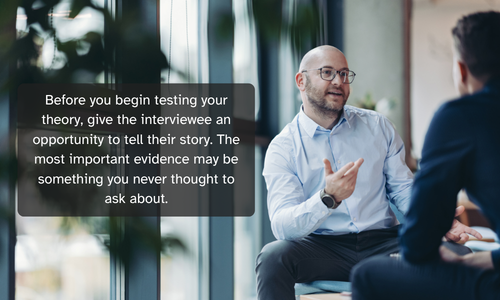
- Start with their story. Investigators sometimes enter an interview with a theory already forming. Then the questions begin testing that theory instead of discovering what the person actually remembers. Give the interviewee an opportunity to explain what happened in their own words. Listen before narrowing the conversation with detailed questions. You may hear something you never thought to ask about.
- Stay curious when something changes. Watch for changes in behavior, tone, pace, or how much detail someone provides. These changes don’t prove deception. They can signal that a topic deserves more exploration. A simple question, such as “Tell me more about that,” can uncover information about workload, communication, work practices, or other conditions surrounding the event. The book emphasizes using nonverbal behavior to guide follow-up, never as proof of truthfulness or deception.
- Remember that an interview is a conversation, not an interrogation. Employees may enter an investigation worried about discipline, embarrassment, blame, coworkers, or simply saying the wrong thing. Some may also be unsure of their own memories. Using emotional intelligence can help people provide a fuller account of what they experienced. Your goal is to collect reliable evidence, not force an answer.
Better Interviews Lead to Better Evidence
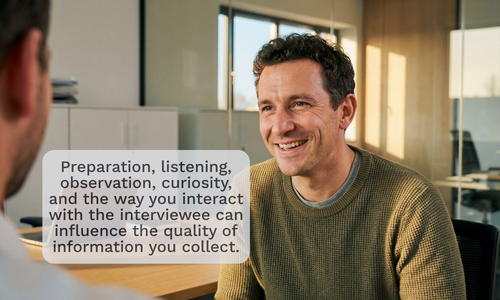
Investigative interviewing requires more than a good list of questions. Preparation, listening, observation, curiosity, and the way you interact with the interviewee can influence the quality of information you collect. Sometimes one detail uncovered during an interview changes your understanding of the entire incident.
Want to Learn More?
Our upcoming evidence collection book by Mark Paradies and Barb Carr takes a much deeper look at investigative interviewing, including the TapRooT® 12-Step Interview Process and techniques for collecting higher-quality people evidence. Look for the new book in early 2027. The new book will be available to all attendees of the Effective Interviewing and Evidence Collection Course at the next Global TapRooT® Summit.