The Blame Game & RCA

What is The Blame Game?
The Merriam-Webster online dictionary defines “the blame game” as:
“A situation in which different individuals or groups attempt
to assign blame to each other for some problem or failure.”
The Oxford English Dictionary traces the first written use of the terminology to the 1958 writing of theatre critic Kenneth Tynan. He wrote:
“The family goes round and round in that worst of domestic rituals,
the Blame Game. I blame my agony on you; you blame yours on her;
she blames hers on me. Father blames his past; mother blames father;
elder son blames both. Younger son blames all of them. If the play has
a flaw it is that O’Neill, the younger son, lets nobody blame him: though
I recall as I write this, the moment his mother cries out that she would
not be what she is if he never had been born (she became addicted to
drugs after a difficult birth- MH). The wheel coming full-circle runs
over them all.”
But the common use of the blame-game terminology is fairly recent. Here is a graph from Google Books Ngram Viewer of the use of the terminology…

The upturn starts about 1985 and peaks in about 2012.
We first wrote about the blame game in our blog in 2008. We were writing about one of our Keynote Speakers at the 2008 Global TapRooT® Summit. We wrote (in an article titled Stop the Management Blame Game):
“Lt. Col. Ralph Hayles, a victim of this blame game after
a military friendly fire accident, told attendees at the 2008
TapRooT® Summit that rapidly placing blame for an accident
at a low level in the organization, is a protective response
by the organization and senior management. “
We previously wrote about the “Blame Vision” in the 2000 book TapRooT®: The System for Root Cause Analysis & Proactive Improvement, written by Mark Paradies & Linda Unger. And still refer to it in our most recent book, TapRooT® Root Cause Analysis Leadership Lessons.
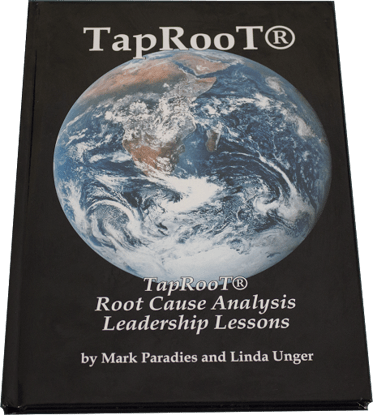
Our first article in the Root Cause Network™ Newsletter that demonstrated the blame vision was written in 1992: “Beat ‘Em or Lead ‘Em … A Tale of Two Plants.” The original was in our first paper newsletter, which is now a collector’s item.
And in 2005, The Wall Street Journal published an ARTICLE about the blame game that featured the foam blame finger seen at the top of this article.
The Blame Game and Root Cause Analysis
We have written about how blame impacts root cause analysis in these previous articles:
- Fighting Fear with Root Cause Analysis, March 2025
- Is Blame Built Into Your Root Cause System?, June 2024
- The Blame Root Cause, August 2019
- Why Does Blame “Make Sense”?, July 2018
The basic problem with the focus on blame in an investigation is that, although it is easy to place blame, in the future, people will be less forthcoming when being interviewed after an accident. There will be many “mystery” incidents (when hidden problems are finally discovered).
When asked what happened, employees know to act like Bart Simpson. They emphatically deny any knowledge of the problem with the following standard answer…

What’s next? A standard corrective action. Punish the guilty party! What if you can’t identify the guilty party? Punish everyone (in low levels of the organization, of course). As we said in the Navy:
“Why be fair when you can be arbitrary?“
For an example of fear causing a witness to play with the truth, read “Trapped in the Blame Vision.”
Avoid the Blame Game with Advanced Root Cause Analysis
If you want to avoid the blame game in your company’s root cause analysis, adopt an advanced root cause analysis system…
TapRooT® Root Cause Analysis
To learn more about TapRooT® Root Cause Analysis, attend one of our public TapRooT® Root Cause Analysis Courses. CLICK HERE for the upcoming dates and locations.
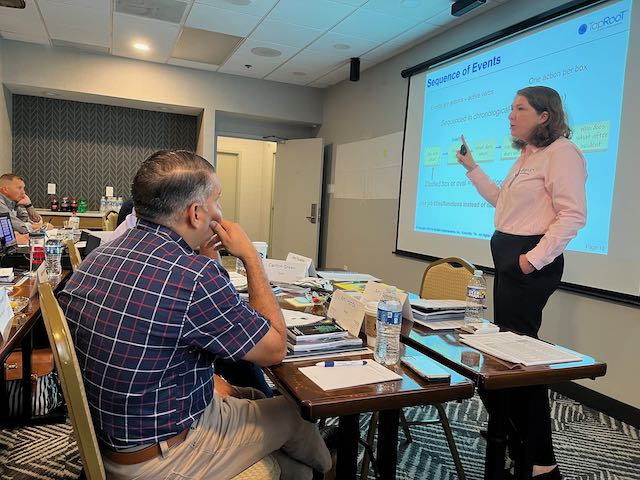
Learn how TapRooT® Root Cause Analysis stops the blame game.
(Note: The Blame Foam Finger is used courtesy of Nate Miller. We are hoping to get more produced so that they will once again be available.)