How to Achieve Quality Root Cause Analysis

Tips to Achieve Quality Root Cause Analysis
Of course, the quality of your root cause analysis depends on the system you use to find root causes. But, there is more to maintaining high-quality root cause analysis in your:
- precursor incident investigations
- quality defect investigations
- learning team events
- equipment failure troubleshooting and investigations
- SIF investigations
than having good initial training to implement a robust root cause analysis technique.
Therefore, in this article, we will have a brief discussion of selecting and implementing an advanced root cause analysis system and a more detailed discussion on maintaining and improving your root cause analysis over time. (Keeping your investigators practiced.)
Choosing a Robust, Advanced Root Cause Analysis System
If you are reading this article, you probably already know that some root cause analysis techniques are substandard. They may be easy or widely used for “simple” problems, but they lack consistency, fail to find real, fixable root causes, and don’t help investigators go beyond their current knowledge. This is especially troubling when investigating human performance issues because a lack of knowledge can lead to a cycle of blaming the employee. I had one manager tell me their system seemed to be:
5-Whys and who do we fire?
Here is a video with Mark Paradies discussing some of the drawbacks of using 5-Whys…
But 5-Whys isn’t the only substandard root cause analysis system. Therefore, before you select a system to implement at your facility, you should investigate what makes a robust root cause analysis system. And that’s what I’ve done for the past forty years. That’s why I wrote an article called the “Fundamentals of Root Cause Analysis” to explain what you need (click HERE to read it).
If you want the simple answer about what you need, the answer is:
TapRooT® Root Cause Analysis
Once you have decided on a robust, advanced root cause analysis system, you will need to implement it at your facility. We’ve written a whole book about that…
Root Cause Analysis Implementation
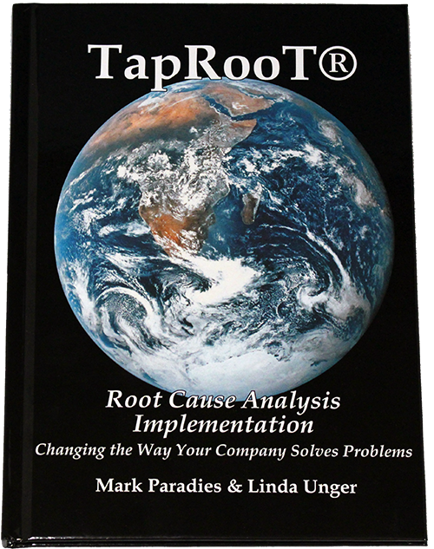
The book includes a detailed explanation of this implementation checklist shown below…

These are key items to consider for achieving a high-quality root cause analysis at your facility.
Once you have implemented your advanced, robust root cause analysis system, you must maintain high standards and initiate a process of continuous improvement.
How to Continuously Improve Your Root Cause Analysis
Implementing a robust root cause analysis system is just the start. Initial training is necessary for facilitators, team members, and general employees to get the process started. However, coaching facilitators (providing feedback) will be needed to improve their skills over time.
Grading a Root Cause Analysis
A tool to help with coaching facilitators to achieve quality root cause analysis is built into the TapRooT® Software.

This tool shown above (from the TapRooT® Software), helps a senior facilitator evaluate and provide feedback to an investigative team about the factors that make a good quality root cause analysis:
- A complete, accurate timeline of what happened is documented.
- All causal factors are identified.
- Root causes, along with supporting evidence, are accurately identified for each causal factor.
- Generic causes are identified for each causal factor (if applicable).
- Effective corrective actions are proposed for each specific root cause for each causal factor.
- At least one proposed corrective action is appropriately high enough on the hierarchy of safeguards list.
- Effective corrective actions for generic causes.
- Corrective actions are specific.
- Corrective actions are measurable.
- Corrective actions are assigned to specific individuals who have the authority and budget to implement them.
- Corrective actions are reasonable (cost-justified).
- Corrective actions have a prompt due date based on their potential for risk mitigation.
- Corrective actions have been reviewed for unintended consequences, and no serious shortcomings have been identified.
- Management has reviewed the root cause analysis and accepted it, and has approved the corrective actions.
- Management has a system to track and manage the implementation of corrective actions.
This investigation grading system was developed by root cause analysis experts and was tested and improved by the TapRooT® Advisory Board Members (over 50 TapRooT® Users from around the world).
One doesn’t have to wait until an investigation is completed to start the process of grading an investigation and coaching a facilitator and an investigation team. The coaching process can be started as the investigation progresses. This “just-in-time” coaching can help investigators learn while they are producing a high-quality root cause analysis. This can save management time by ensuring they get a high-quality RCA for their review and approval.
More Ideas to Improve
Every year, we identify more ways to improve root cause analysis and performance (safety, quality, equipment reliability, high-reliability systems, and human performance). In 1994, we held our first conference to share the ideas we had discovered, plus insights from thousands of TapRooT® Root Cause Analysis Users. The Conference is called the Global TapRooT® Summit. It is scheduled every 18 months. To enhance your root cause analysis and safety, as well as quality, equipment reliability, human performance, and overall performance reliability, plan to attend the Summit. Get the latest information at THIS LINK. (The next Summit will be in the Spring of 2027 in Texas. Watch for more information as the planning progresses.)