Writing TapRooT®: The TapRooT® Authorship Journey

The current ten book series that teaches the TapRooT® System has had a long and winding road of creation, revision, and collaboration to become what TapRooT® Users know and love today. In celebration of National Author’s Day, we are taking a closer look at our president, Mark Paradies, and his writing career.
An Author’s Backstory
Mark’s story with writing began early, as he enjoyed writing since he was in high school.
“When I was a junior I became the editor of the school newspaper and I got myself into all sorts of trouble because I wrote jokes in there, I wrote some sarcastic articles in there… The cooks all threatened to quit once because I wrote a whole page of jokes about lunchroom cooking and they got all mad. So I really enjoyed writing. But then I went to college to be an engineer and I didn’t really get a lot of chances to write.”

In that space without writing, however, Mark discovered his interest in human engineering, and fell in love with understanding how mistakes were made, and how people could be protected from the consequences of accidental action. Mark’s experience in the Nuclear Navy, his research at the University of Illinois, his experience improving human performance at Du Pont, and his research for the NRC, the TapRooT® Root Cause Analysis System was created to help people find the root causes of human errors and equipment failures.
“It was in 1991 that we started on the first TapRooT® Manual. We had a customer who wanted a 2-day course, and we wanted a book to go with the course. But the first TapRooT® Manual came with a considerable time crunch. “We had a course coming up, so we had to write the manual quickly! So Linda Unger and I split the writing up. She took certain chapters, and I took others. Each chapter was its own little book. There’s a SnapCharT® book, there’s a Root Cause Tree® book, there was a Safeguards Analysis book… And they were all bound in a three-ring binder. We’d imagined that in the future we could just rewrite a book, so you could take the old one out and clip the new one into the binder.”
The idea was a worthwhile preemptive measure to keep the updates from getting out of hand. But in each revision, we rewrote all the books. That lasted until 1999.
The Process of Crafting
Soon the binder-clad TapRooT® Manual became the first hardback book. The writing of what Mark affectionately calls “the green book” began in 1999, and began with a bang.

“The green book was our first hardback book. This was the one that we couldn’t get around to writing here in the office. So we scheduled a week in Port Angels, Washington, at a bed and breakfast. We sat on a porch overlooking the Strait of Juan de Fuca with our laptops on our laps, watching eagles fly by as we wrote and revised. Linda would ask me questions and I would ask her questions, and she’d hand me her chapters and I would hand her mine, and I’d make edits and she’d make edits.
“There were so few distractions. Cell phones didn’t work there. The only problem we had was that the internet was weak, so it was hard to look things up. But we wrote uninterrupted for a week. All-in-all it was a great place to work. We wrote most of the book in a week.
That was the first draft. Then, of course, you have to take it back to get everyone to review it, and have it proofread. Next, it went down to the printers, and they have to look at it. Then to the bindery. But we got all of the content written in one week.”
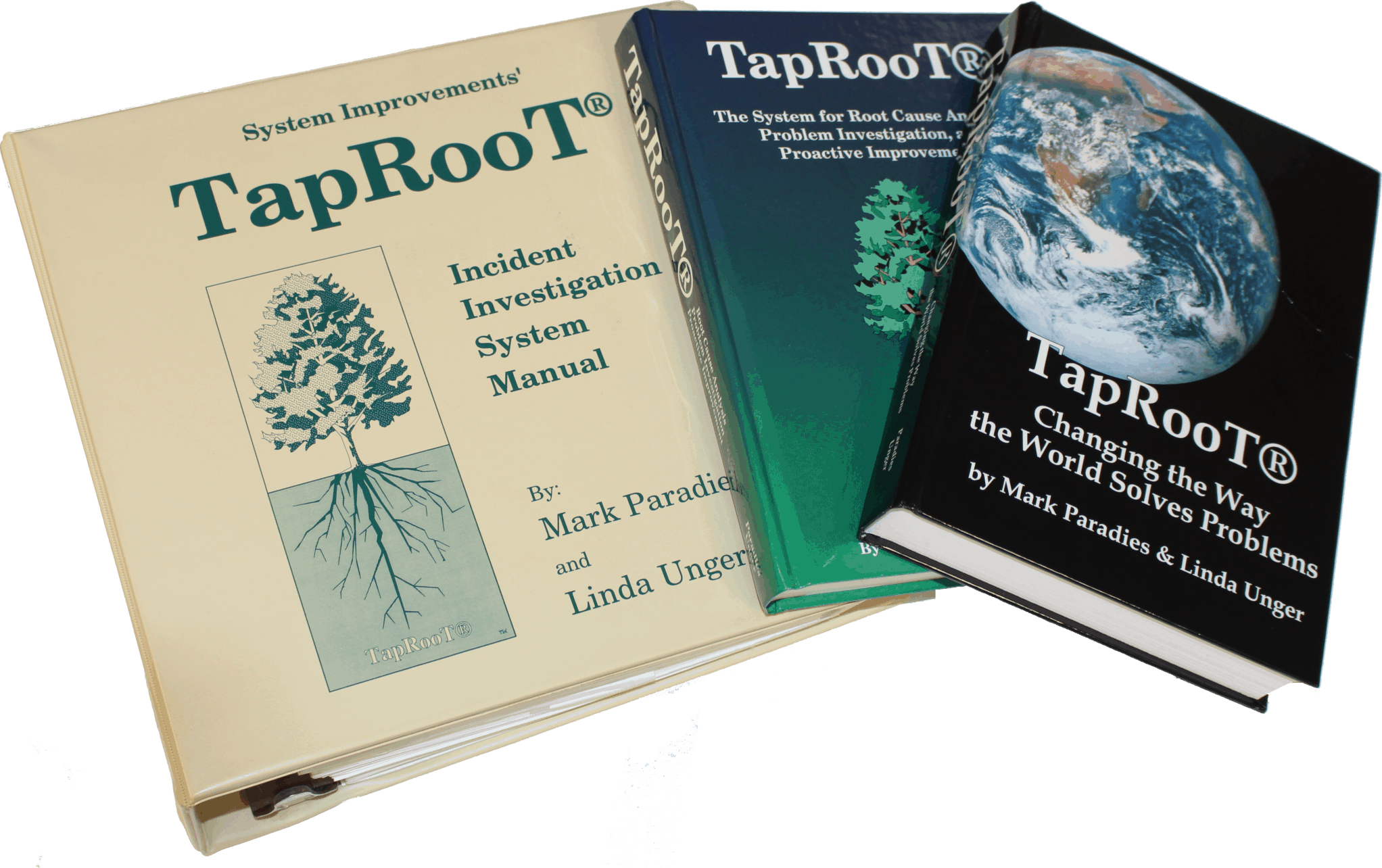
The second hardback book was written in 2008, after binding hardback books had become a rarer practice. “We had to figure out how to actually make the book, and that was a whole process. By the time we wrote that second book, the US was down to maybe two binderies because of the rise of print on demand and Kindle.”

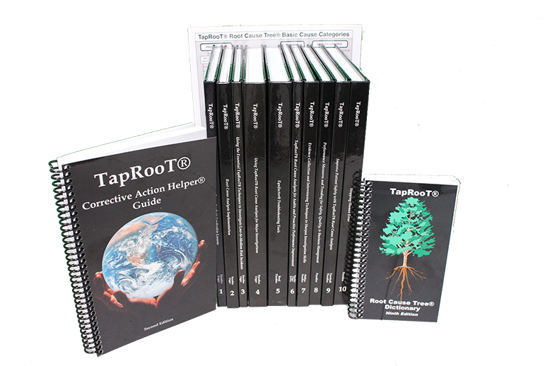
After the 2008 hardback book, we decided that the next edition would be several smaller books. We thought these little books would be more likely to be read .”
These books helped to create the structure of the TapRooT® System to this day. “We had a sequence for them. Number three went with the 2-day course and number four went with the 5-day course. We had a theory of TapRooT® book that was number one and number two was how to implement the TapRooT® RCA System. We ended up with ten volumes, the first one coming out in 2015 and the most recent one coming out in 2020.”
The process of creating the TapRooT® books was a collaborative train of thought, each idea leading to a hundred more ideas demanding that their story be told. With every concept committed to paper, however, new lessons had to be learned about how to write best practices for RCA users around the world.
Lessons Learned
“When it came to writing the TapRooT® System down, the System Improvements team aimed to practice what they preached, analyzing and improving upon the past books each time. Mark describes some of the difficulties of this process, saying, “I think writing the small books was harder than writing the big books. I mean, if you look at the size of the first big black book compared to ten smaller books, it’s really much more information. Even though they were ‘small’ books, they had a lot of important information about performance improvement.”

Just as TapRooT® RCA teaches about good training, however, practicing makes good information more memorable. Consistently teaching RCA made some of the small books significantly easier to write. “Book three was easy. It was the 2-day course so we taught it a lot. A lot of the stuff that was in there was already in the black book to start with, so you could take stuff out of the big black book, make the little books, and then there was updating and editing.
And yet writing as a whole, despite Mark’s love for the practice, was not an easy journey. “It’s a lot harder than you think. Technical books tend to be really dry, and we didn’t want our books to be really dry. We have technical stuff in there, but we wanted to use lots of examples that make people go ‘oh, yeah!’ It was hard making it interesting but I think we did a fairly good job of it. These books aren’t boring. It’s not like writing a novel. That has its own challenges. But these are technical books so you really have to work at making them interesting. You can’t just say ‘this is how you do this.'”
Mark insists that the secret to writing interesting technical books is stories.
“Stories. You have to build stories into the books. If there’s a story involved people are going to be interested. Our stories were all from our past history. These were things we did, these were things we knew. This book was made up of our stories.”
The End is Yet to Come
In the midst of all the changes the TapRooT® books have undergone, one of the most important lessons they had to overcome was to keep the information from atrophying over the years. “When you know you’re not going to write another one a year from now, two years from now, you really have to think about what you want to put in there and not have it be quickly outdated.”

But the secret to keeping books from becoming outdated is not to write it perfectly the first time; it is to update it alongside what you’ve learned. “We learned a lot in all those years, from 1991 to 2015. What we really wanted was to put this knowledge we’d gained into writing. Socrates had this idea, he said that you should never write anything down because an idea was constantly developing and changing, but if you wrote it down it became concrete. Just the opposite was true for us, it was as you get more things you have to change what you write, so you have to come up with different versions of the book as you go along.”
We intend to continue this process as our TapRooT® books go into their next phase of revision. “We’re starting now. Barb’s already rewriting the Interviewing Book. From a legacy point of view it’s time to start getting somebody else to write the books… Some things will become outdated because there will be new regulations that come along or new requirements that come along and that’s why you decide you need to rewrite a book. It’s a never ending story, you keep changing things as time goes on, but the more knowledge we have and the more we put into the book, the less common the changes have to be.”
If you are interested in reading our story-packed RCA books for yourself, you can read more about TapRooT® Books here.
To purchase TapRooT® Books, visit our store.